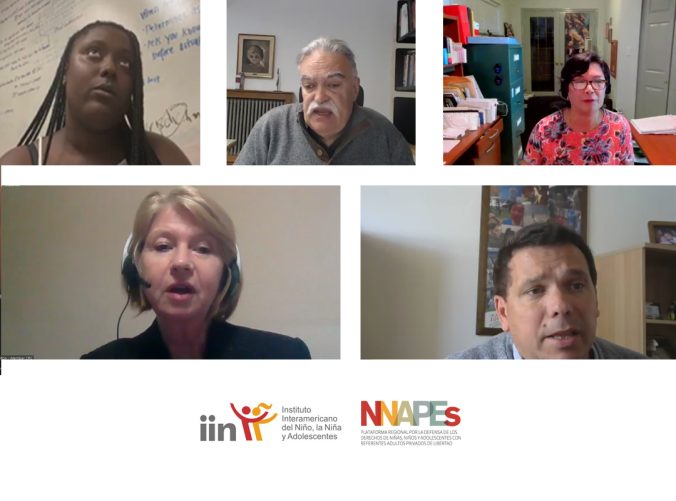
Más de 400 personas participaron en este encuentro que tuvo lugar a través del formato virtual. El evento fue organizado por la Dirección de Niñez en Contexto de Encierro, de la Subdirección General de Políticas de Género de la Dirección General de Asistencia y Tratamiento del Servicio Penitenciario Bonaerense.
Desde la Plataforma NNAPES, participaron Lía Fernández (Secretaría Ejecutiva), Luis Sepúlveda (Enmarcha-Chile) y Amira Di Pizzo (ACIFAD-Argentina).
“Aunque no tengamos lugar de decisores de políticas públicas, todos podemos hacer algo desde el lugar que nos toca”, señaló Lía Fernández, quien habló sobre la conceptualización de NNAPES, que comprende una diversidad de situaciones y contextos cuando un familiar es privado de libertad. Fernández también mencionó los impactos que se generan cuando un niño, niña o adolescente tiene un familiar privado de libertad y cómo desde el trabajo en territorio resulta desafiante generar propuestas atractivas a nivel comunitario, para sacarlos/as de los circuitos de violencia en los que muchas veces están insertos/as.
En este sentido, Luis Sepúlveda, desde Enmarcha (Chile) comentó el trabajo que viene realizando el proyecto Abriendo Caminos en comunidades alejadas de los centros urbanos. “Es muy importante hacer una lectura socioterritorial para tener una lectura comunitaria”, señaló al respecto del trabajo que realizan. Sepúlveda también comentó acerca de las acciones participativas que han realizado niños, niñas y adolescentes en los últimos años en el marco de este proyecto, como la iniciativa Si yo fuera juez, que propició instancias de participación de NNAPES en el ámbito del sistema judicial. Por su parte, desde ACIFAD (Argentina), Amira Di Pizzo, presentó datos acerca de una investigación realizada sobre las mujeres que tienen familiares privados de libertad, quienes en la mayoría de los casos se encargan de los roles de cuidado de las personas privadas de libertad, así como de los niños, niñas y adolescentes. Entre las tareas diarias que realizan estas mujeres se encuentra trabajar, el 80% de estas mujeres aseguró que visita a su familiar detenido. Las visitas a la cárcel son una actividad más que se integra a otras tareas como trabajar, tareas domésticas y cuidado de niños y niñas.
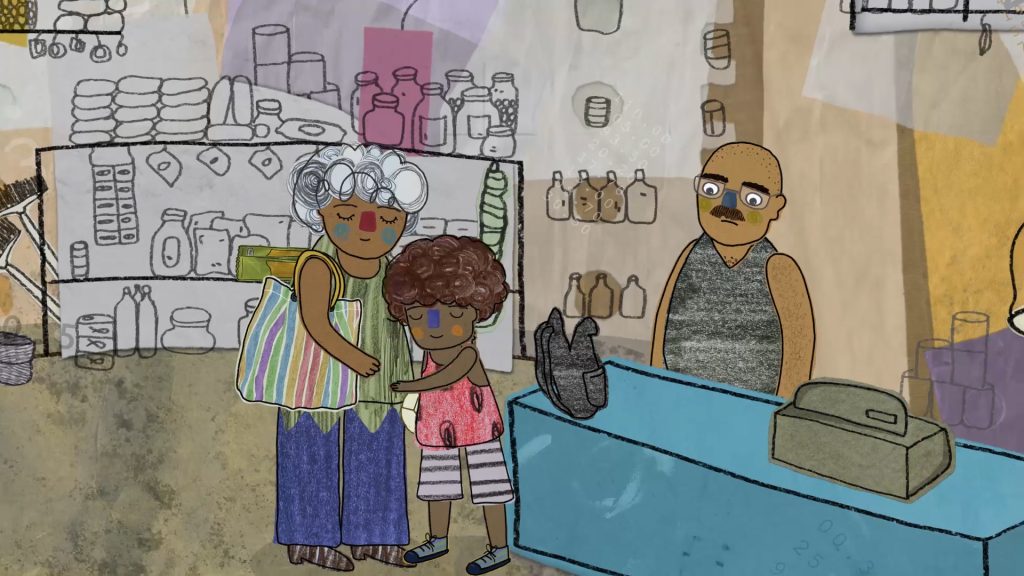
This is a four-episode series made together with the Argentine channel Pakapaka that included the participation of children and adolescents with relatives deprived of their liberty.
Each one of the episodes focuses on a situation that these children and adolescents experience at some point during the imprisonment of a relative: assuming adult roles, going to visit the relative in a detention center and what that implies, or being subject to discrimination and stigma in educational centers and/or in their neighborhoods.
“In each video I felt that I had a little bit of me”, commented several of the adolescents and young people who participated in the regional presentation of the series: “They tell what we went through and it is not denigrating us, they express what many of us feel and not We can express it.” Manuel, Estefanny, Felicia and Cris moved everyone with their perceptions about the episodes.
In the creative process and in the voices, children and adolescents participated with adult references deprived of liberty. “This series was made with a lot of love and respect, we are very excited about the final work, but much more about the process”, commented Cielo Salviolo, Director of Pakapaka.
“We are super happy, because the fundamental objective is to give visibility to the reality that 2.5 million children and adolescents live in Latin America and the Caribbean,” said Lía Fernández from the Executive Secretariat of the NNAPES Platform.
In addition, the short films are accompanied by an activity guide for mothers, fathers, educators, teachers and all those who want to address the issue with children and adolescents.
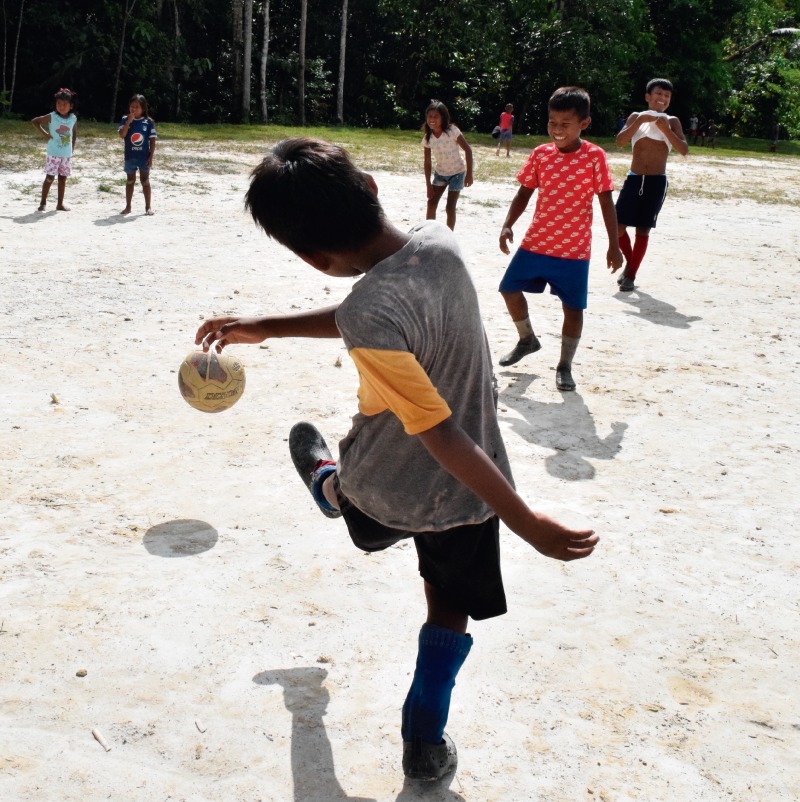
This organization was created in 2006 in Altos de Cazucá, precisely in the Soacha neighborhood, located on the outskirts of Bogotá, based on the problems that children and adolescents lived and live in that area. From its beginnings, soccer was a tool for social inclusion, which forged the mission of the Foundation: activate the power of the game to generate hope, autonomy and belonging. Currently, the organization develops more than 20 proposals, bringing together more than 1,500 children and adolescents.
In recent years, the organization has incorporated a programmatic line linked to the adolescent criminal responsibility system, since some young people with whom they worked were deprived of liberty. In this sense, a methodology was developed in contexts of deprivation of liberty, where the adolescents themselves lead artistic and cultural proposals, accompanying them on their discharge. In turn, the Tiempo de Juego team has also developed care proposals for young people who have been institutionalized once they graduate.
In this process, they have found that many young people have stories where their relatives are or have been deprived of liberty. At the same time, several of these young people deprived of liberty have small sons and daughters.
The reality that Tiempo de Juego identifies is the reality of hundreds of organizations in Latin America and the Caribbean. Incorporating their perspective and their experience in this problem will contribute to the strengthening and expansion of the actions of our Platform.
The initiative is part of the alliance of the NNAPES Platform with the Inter-American Institute for Children and Adolescents of the OAS (IIN-OEA), who have been working together for five years in the incidence and visibility of the problem of children and adolescents with adult references deprived of liberty.
The course, called Protection, promotion and fulfillment of the rights of children and adolescents with caregivers deprived of liberty, already has 5 editions in its Spanish version and has trained more than 100 operators of the protection, justice and penitentiary in 17 countries of the region.
At the launch of the training, Gonzalo Salles, representative of the Executive Secretariat of the NNAPES Platform, highlighted that this course will make it possible to reach actors, governments and countries that would otherwise be very difficult to reach, and also added that it will make it possible to put the topic on the agenda in countries where this topic is still invisible.
For his part, Víctor Giorgi, Director General of the IIN, mentioned the impacts that having one of their relatives deprived of liberty generates for children and adolescents, which include multiple violations, psychological and emotional affectation, assumption of adult roles and discrimination in their environments, among others. “The state as a whole must assume the need to minimize the damage,” said Giorgi regarding the responsibility of the states in the development of public policies aimed at this population.
Olu Olgunlade, a young member of the Youth Action Council of the Osborne organization, participated in the event, who told her story with a family member deprived of liberty and how sharing her experience with other people who were going through the same situation helped her. Among his recommendations for people who work with children and adolescents with adult references deprived of their liberty, he stressed the importance of taking into account that this is an extremely sensitive issue for them and that this should be a strategic point in all the actions.
From the Committee on the Rights of the Child, Professor Ann Skelton highlighted that this problem is of great interest to the Committee and valued the work of civil society to make the issue visible. Likewise, he stressed that this training will allow other actors to replicate these practices and for the issue to be installed on the agendas.
“In Canada we don’t know how many NNAPES there are,” said Vivienne Chin, Senior Associate at the International Center for Criminal Law Reform and Criminal Justice Policy in Vancouver, Canada. Along the same lines as Skelton, Chin valued the work of social organizations as representatives of the voices of children and adolescents and also highlighted their role as watchdogs of state actions.
These words are part of the story of Estefanny, a young woman from Uruguay and representative of the NNAPES Platform, who told her story in the conversation dedicated to the problem of children and adolescents with adult references deprived of liberty, within the framework of the Commemorative Days for the 10 years of the Legal Research Institute of the University of Chiapas.
The instance was organized by researcher Corina Giacomello, member of the Institute’s Criminal Policy Research Group. Giacomello commented that this “is an issue that is quite invisible, we only think of the person who is deprived of liberty, we rarely turn to see the families that are made up of children and adolescents supported by female caregivers.”
“The deprivation of liberty means the deprivation of childhood,” said Chiara Altafil, research director at Global Campus Human Rights (Venice, Italy), who also participated in the discussion and presented the global study on childhoods deprived of liberty.
This study seeks to reconcile the exercise of rights with the criminal justice system, from pretrial detention, sentencing, separation and reinsertion, Altafil said.
Among its conclusions, the research indicates that strict regulations are not effective because they do not allow careful evaluation between the different interests that are at stake on a case-by-case basis, for which many problems could be avoided if non-custodial measures are applied.
From the NNAPES Platform, in addition to Estefanny, Luciano Cadoni, representative of Church World Service Latin America and the Caribbean, participated, who presented the work that the coalition has been doing, at the regional level, in terms of good practices in advocacy and awareness of the theme.
“There is a lot to be done, there is a lot of pain, a lot of violence, a lot of actions and a lot of losses that could be mitigated if there were actions that were taken in due time and if those who have to do things do them,” said Cadoni.
Estefanny: A story of resilience
Estefanny lived her adolescence marked by her father’s imprisonment. At the age of 15, he had to stop studying, take care of his younger brother and dedicate himself to providing for his family, since his mother was ill and died shortly after his father was imprisoned. In addition to this, in the absence of her mother, she was also the one who had to follow her father’s case at the judicial level.
“We did not receive any help from the State, my mother was sick and could not work and we began to support ourselves with garbage collection, which my father used to do, and since he was deprived of liberty I had to do it with a neighbor. the neighborhood,” he recalled.
The young woman expressed that it was from the support of the organization Gurises Unidos that they were able to get ahead. “I learned what a psychologist was thanks to Gurises Unidos,” he said, adding that his brother also had help at an educational level. Even the organization managed the possibility so that they could visit their father after the death of their mother.
“Today I speak it with tremendous naturalness, because I already lived it, I accepted it and I got over it, but at that moment you wanted to go because he was your father and you hadn’t seen him for a week, but you didn’t want to go because they treated you horrible and you had no privacy,” he commented on the difficult time of prison visits.
Her father is currently free, however, his passage through that site affected him in such a way that it caused a break in the bond between father and daughter: “When he came out, the relationship distanced a bit, we did not have the same trust, we had more conflicts, he didn’t get a job, he had to go back to collecting garbage, the state didn’t give him anything.”
Despite all the difficulties she has had to live through, Estefanny and her brother have come out ahead: “Today I am proud of him, because he was able to finish studying, he works, he is a father, he gives me that peace of mind that things were done well and that we were both able to go our separate ways despite what we went through 10 years ago.”
For her, it is essential that states develop specific policies that allow addressing this situation from the moment of the arrests until the departure and reintegration of family members. In this sense, better conditions for visits must be achieved, as well as financial and psychological support for families in the process of depriving their relatives of liberty. It is also important that judicial processes be expedited, since families have the right to know how long their relatives will be deprived of liberty.
The initiative included 150 members of the Guatemalan Penitentiary System, who received a workshop on “Protocol for specialized care for girls, boys and adolescents with relatives deprived of their liberty in the different preventive detention centers and sentencing by the Directorate General of the Penitentiary System”.
The objective of this workshop was to strengthen the knowledge and capacities of prison employees in order to guarantee the rights of children and adolescents in the framework of their work and professional performance.
The initiative is part of the legal effects contained in the judgment of file No. 01174-2020-0649 of the special process for the comprehensive protection of children and adolescents threatened or violated in their human rights.
The proposal was divided into four modules. In the first, the background, legal basis, and concepts of the subject were addressed, while in the second, judgment, guiding principles, and responsible actors were discussed. During the third module, the protocols and procedures for the care of girls and boys from 0 to 4 years of age who cohabit with their parents deprived of liberty were addressed. And in the fourth module, we worked on the protocols and procedure for general visits of girls, boys and adolescents in detention centers.
During the activity, representatives of the Colectivo Artesana, the National Civil Police and the Penitentiary System participated. The activity was carried out with the support of the Artisan Collective and Unicef.
Se trata de una serie de cuatro capítulos realizada junto al canal argentino Pakapaka que contó con la participación de niños, niñas y adolescentes con referentes familiares privados de libertad.